Short answer: ordering catering for a 10-person meeting and a 20-person meeting are two different jobs. At 10 people, individual boxed meals ordered 24–48 hours out are almost always the right call. At 20 or more, you switch to a drop-off buffet or a mixed order, add 3–5 business days of lead time, plan a real serving table, and build in a dietary buffer. This guide gives you the numbers, the timing, and the checklists for both.
Most office lunches don’t go wrong because the food is bad. They go wrong because the order was sized for one kind of meeting and served at another: not enough vegetarian options, food that arrives while the client is still presenting, or a buffet crammed onto a 4-foot credenza with 22 people trying to reach it. Below is how to get it right, broken down by headcount.
The five decisions that determine everything
Before you open a single menu, lock these five in writing. Every other choice follows from them. If you also want the wider planning picture — service styles, vendor vetting, day-of execution — start with our complete corporate catering guide.
- Confirmed headcount — not the invite list. Ask for RSVPs with a deadline 3 business days out.
- Budget per person, all-in — food plus delivery, tax, and tip. Not the menu price alone.
- Serving format — individually boxed, drop-off buffet, family-style platters, or stations.
- Delivery time, not meeting time — food should land before the room fills, not with it.
- Setup space — measure the table you actually have. This is the constraint people forget.
Corporate catering budget: what to expect per person in 2026
Per-person pricing depends far more on format than on cuisine. These are typical U.S. ranges; major metros (New York, San Francisco, Boston, Washington D.C.) commonly run 20–40% above them, and smaller markets run below.
| Format | Typical per person | Best for | What is included |
|---|---|---|---|
| Breakfast / continental drop-off | $12–$22 | Morning meetings, training kickoffs | Pastries, fruit, yogurt, coffee service |
| Boxed / individually packaged lunch | $14–$25 | Working meetings, interviews, all-day sessions | Entrée, side, dessert, utensils per box |
| Drop-off buffet (hot or cold) | $20–$35 | Team lunches, lunch-and-learns, all-hands | Trays, serving utensils, setup by you |
| Staffed buffet or family-style | $40–$70 | Client hosting, executive visits | On-site staff, chafing dishes, cleanup |
| Full-service plated | $70–$130+ | Board dinners, galas, holiday parties | Servers, rentals, multi-course service |
The line items that surprise finance teams
- Delivery fee: often a flat $15–$85 depending on distance, building access, and order size.
- Tax: applies to food and, in many states, to the delivery fee as well.
- Gratuity: 10–20% is standard for drop-off; staffed service typically carries an 18–22% service charge.
- Dietary premium: gluten-free and specialty items often price 15–30% above the standard box.
- Rush surcharge: same-day and under-24-hour orders can carry a premium, when they are accepted at all.
Why 10 people costs more per head than 20
Fixed costs do not scale down. A $50 delivery fee spread over 10 boxes is $5 per person; across 20 boxes it is $2.50. Add the fact that many restaurants set catering minimums between $100 and $250, and small orders quietly land in a higher effective tier.
| Sample working-lunch math | 10 people | 20 people |
|---|---|---|
| Food at $18/person | $180 | $360 |
| Delivery fee (flat) | $50 | $50 |
| Tax (est. 8%) | $18 | $33 |
| Tip (15%) | $27 | $54 |
| All-in total | $275 | $497 |
| Effective cost per person | $27.50 | $24.85 |
Illustrative example. Fees and tax vary by restaurant and state — always confirm the all-in total before submitting for approval.
Practical takeaway: if you are ordering for 10 and you are near a restaurant’s minimum, upgrading the menu often costs less than you would think, because the fixed fees are already paid. And if two teams are eating on the same day, combine into one drop-off and split the fee.
What kind of food to order for a business meeting
The rule that survives every office: the food should be edible with one hand, at a table, while someone is talking. That eliminates more menus than any dietary restriction does.
Formats that work in a conference room
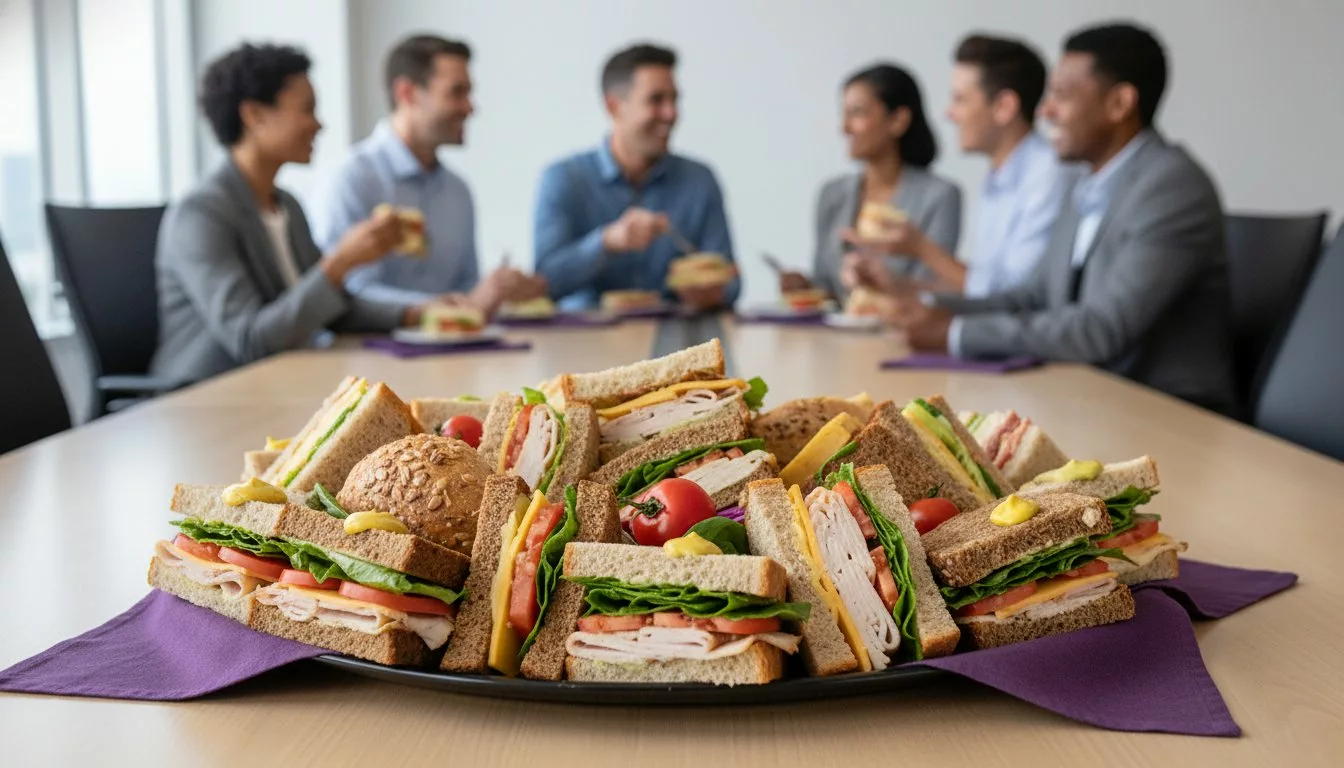
- Individually packaged meals — fastest to distribute, no serving line, easiest to label for allergies, zero over-ordering. The default for working meetings.
- Drop-off buffet — more variety per dollar and better for mingling, but needs 8–10 feet of table and 15–20 minutes of self-service traffic.
- Family-style platters — good for team-building and small conference tables; cost-effective and communal.
- Build-your-own stations (taco bar, grain bowls, sandwich bar) — excellent for 20+ because every diet is handled by the same setup.
Cuisines that consistently land well
| Cuisine | Why it works | Watch out for |
|---|---|---|
| Sandwiches and salads | Universally safe, easy to portion, travels well | Repeat fatigue if you order weekly |
| Mexican | Build-your-own handles vegan, GF, and dairy-free in one setup | Sauces travel; keep them separate |
| Mediterranean | Lightest option; strong vegetarian coverage by default | Portion protein carefully for big eaters |
| Asian (bowls, noodles) | Reheats and holds well; broad appeal | Peanut and soy allergens need labeling |
| BBQ and comfort | High satisfaction for celebrations and all-hands | Messy and heavy — bad before an afternoon of work |
| Breakfast | Cheapest per head; ideal for early sessions | Coffee logistics: order more than you think |
What to avoid for meetings
- Anything requiring a knife and fork over a laptop.
- Strong-smelling dishes that linger in a closed conference room.
- Heavy fried or cream-based mains before an afternoon working session.
- A single-option menu with no vegetarian entrée — the fastest way to leave someone with a side salad for lunch.
Dietary planning by the numbers
A reliable planning baseline for a U.S. office: roughly 20–30% of any group will want a vegetarian or plant-based option, and you should assume at least one gluten-free and one nut-allergy requirement in any group of 20. Ask on the RSVP, order the alternates as clearly labeled individual portions even when the rest of the meal is a buffet, and keep those portions off the shared serving line so they do not disappear.
How much food to order
| Item | Planning rule |
|---|---|
| Buffet lunch | 1 entrée + 2 sides per person; order for 90–100% of confirmed headcount |
| Boxed lunch | Exactly your confirmed count, plus 1–2 spare boxes |
| Sandwiches and wraps | 1.25 per person (halves make this easy) |
| Appetizers as the meal | 10–12 pieces per person |
| Appetizers before a meal | 3–5 pieces per person, per hour |
| Salad or sides as a shared tray | Half-tray = 8–10 servings; full tray = 18–22 |
| Beverages | 1.5 drinks per person for a 1-hour lunch |
| Coffee | 1 gallon = 16 eight-ounce cups; plan 1.5 cups per person at breakfast |
Buffets get eaten harder than boxes. People serve themselves 10–15% more than a caterer would portion. If your buffet keeps producing leftovers, drop your order count by 10% rather than changing the menu.
Timing: when to order and when to schedule delivery
Lead time by order size
| Headcount | Standard lead time | Complex or hot buffet | Holiday season / peak |
|---|---|---|---|
| Up to 10 | 24–48 hours | 2–3 business days | 1 week |
| 10–25 | 2–3 business days | 3–5 business days | 1–2 weeks |
| 25–75 | 3–5 business days | 1 week | 2–4 weeks |
| 75+ | 1–2 weeks | 2–3 weeks | 4–8 weeks |
Delivery window vs. meeting start
The single most common scheduling mistake is booking delivery for the time the meeting starts. Build a buffer:
- 10 people, boxed: schedule delivery 20–30 minutes before service.
- 20+ people, buffet: schedule delivery 45–60 minutes before service. Setup alone takes 15–20 minutes.
- Large or secured buildings: add another 15–30 minutes for dock check-in, security, and freight elevators.
Hot food holds well for about 30–45 minutes in insulated packaging; beyond that, quality drops noticeably. If your meeting is likely to run long, boxed meals or cold platters are the safer format.
Two scheduling rules worth adopting
- Order by 2:00 p.m. for next-day delivery. Most kitchens cut off catering prep for the following morning in the early afternoon.
- Tuesday through Thursday are peak. If your date is flexible, Monday and Friday slots are easier to book and occasionally cheaper.
Delivery and setup: the details that decide whether it goes smoothly
Everything below belongs in the delivery instructions field of your order, not in your head:
- Full address plus floor, suite, and the specific room name.
- Entrance to use — main lobby, loading dock, service elevator — and whether the driver needs to check in with security or show ID.
- Parking reality: metered street, garage clearance, or a 10-minute loading zone.
- An on-site point person with a mobile number, plus a backup name.
- Whether serving utensils, plates, napkins, and cutlery are included — confirm this explicitly; it is the most common gap in a drop-off order.
- Certificate of insurance (COI) requirements, if your building requires one from vendors.
Table space you actually need
A standard 6-foot table holds a drop-off buffet for roughly 20–25 people. For 40+, run a double-sided line or split into two identical stations — a single line moves about 60–80 people per 20 minutes at best, and slower once people start deliberating over the sides.
10 people vs. 20+ people: the side-by-side
| Decision | Meeting for ~10 | Meeting for 20+ |
|---|---|---|
| Best default format | Individually boxed meals | Drop-off buffet or build-your-own station |
| Menu variety | 2–3 options total | 3–4 mains + 2–3 sides, plus labeled dietary alternates |
| Lead time | 24–48 hours | 3–5 business days |
| Delivery buffer before service | 20–30 minutes | 45–60 minutes |
| Effective cost per person | Higher — fixed fees spread thin | Lower — fees amortize, volume pricing may apply |
| Dietary handling | Ask each attendee individually | Assume 20–30% vegetarian; label everything |
| Setup space | A credenza or the end of the table | 6–8 ft of dedicated table, clear traffic path |
| Staffing | None needed | None for drop-off; consider staff above 50 or for client-facing events |
| Serving time | 2–3 minutes | 15–20 minutes through the line |
| Ordering approvals | Usually a manager’s card | Often needs a PO or invoiced billing — start earlier |
| Biggest risk | Hitting the restaurant’s minimum | Under-ordering variety; food arriving with the meeting |
If you order regularly: turn it into a program
Teams that cater weekly or monthly leave real money and time on the table by treating each order as a one-off. A few structural moves:
- Build a rotation. Four to six restaurants on a repeating cycle prevents menu fatigue without new research every week.
- Standardize the order. Two or three core options plus one or two dietary alternates lets the kitchen buy in bulk — the same reason simplified menus price better.
- Save your locations and delivery instructions. The floor, dock, and contact details should not be retyped every time.
- Consolidate billing. One invoice per month is far easier to reconcile than twelve receipts, and makes budget tracking possible at all.
- Keep a reorder list. The fastest way to handle a last-minute meeting is to repeat an order that already worked.
The pre-order checklist
Copy this into your order notes and fill it in before you check out:
- Confirmed headcount: ____ | Vegetarian: ____ | Gluten-free: ____ | Allergies: ____
- Event date and service time: ____ | Requested delivery time: ____
- All-in budget cap (food + delivery + tax + tip): $____
- Format: boxed / buffet / family-style / station
- Delivery address, floor, room, entrance, parking notes: ____
- On-site contact + mobile, plus backup: ____
- Serveware confirmed: plates, cutlery, napkins, serving utensils
- Dietary meals individually labeled
- Payment method and approval or PO in place
Five mistakes that cause most catering problems
- Scheduling delivery for the meeting start time. Always build a buffer.
- Collecting dietary needs the day before. Late accommodations cost more and sometimes cannot be made at all.
- Forgetting serving utensils. A buffet with no tongs is a buffet nobody can serve.
- Budgeting from the menu price. Delivery, tax, and tip typically add 25–35% to the food subtotal.
- Ordering for the invite list instead of the RSVP list. Real attendance is usually 5–10% lower.
Order catering for your next meeting
OnCater connects you with local restaurants that handle corporate orders, with real menus and real prices you can compare before you order — no quote requests, no phone tag. Browse restaurants that deliver to your office, schedule for any date, and get support by phone at 1-888-669-1292 if you would rather have someone walk through a large order with you.
Find catering near your office on OnCater
Frequently asked questions
How much catering do I need for 10 people?
For a working lunch, order 10 individually boxed meals plus one or two spares, or a buffet built on one entrée and two sides per person. Budget $14–$25 per person for boxed meals and $20–$35 for a drop-off buffet, before delivery, tax, and tip. Because delivery fees do not scale down, expect an effective all-in cost closer to $25–$32 per person at this size.
How much catering do I need for 20 people?
For 20 people, plan 3–4 main options plus 2–3 sides, and order for 90–100% of your confirmed headcount. A drop-off buffet at $20–$35 per person puts food between $400 and $700, with delivery, tax, and gratuity adding roughly 25–35%. Add at least 4–6 vegetarian portions and label all dietary meals individually.
How far in advance should I order catering for a business meeting?
For 10 people, 24–48 hours is usually enough. For 20 or more, order 3–5 business days ahead, and 1–2 weeks ahead for hot buffets or during the November–December holiday season. Same-day orders are sometimes possible but limit your restaurant choices and may carry a rush premium.
What time should catering be delivered for a lunch meeting?
Schedule delivery 20–30 minutes before service for boxed meals and 45–60 minutes before service for a buffet that needs setup. Add 15–30 more minutes for buildings with loading docks, security check-in, or freight elevators. Hot food holds well for about 30–45 minutes, so do not build in more buffer than that.
What is the best food to order for a corporate meeting?
Choose food that can be eaten with one hand at a table: sandwiches and salads, Mediterranean plates, grain or noodle bowls, and build-your-own taco or bowl bars. Avoid dishes that need a knife and fork, strong-smelling items in closed rooms, and heavy fried food before an afternoon of work. Always include a vegetarian entrée, not just vegetarian sides.
Is it cheaper to order catering or give employees a meal stipend?
For groups above roughly 20–30 people, catering is usually cheaper per head than individual delivery stipends, because you avoid per-order delivery fees and service charges on every single meal. It also produces a shared lunch instead of twenty people eating separately at their desks, which is often the actual goal.
Do I need to tip on a catering delivery?
Yes. For drop-off catering, 10–20% of the food subtotal is standard. Staffed service typically includes an 18–22% service charge — check whether that charge goes to the staff before adding a separate tip on top.